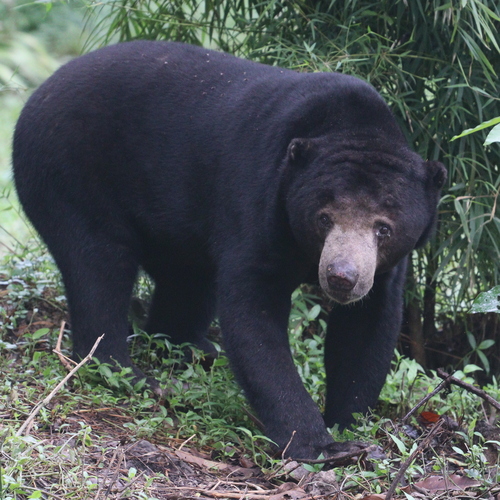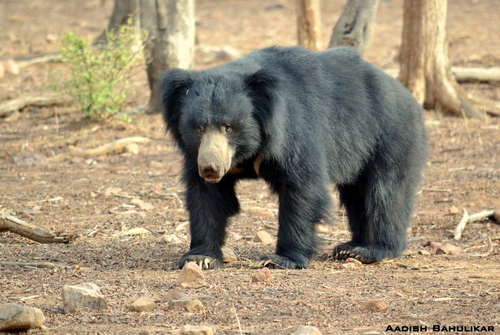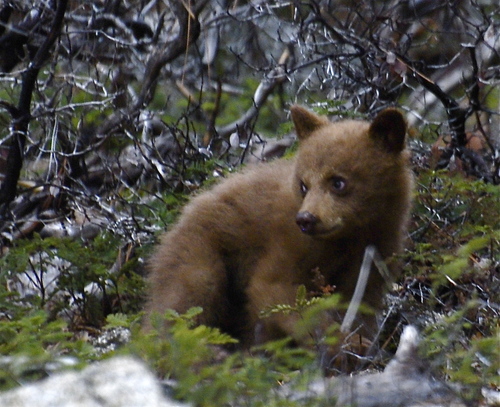
Ursus thibetanus, l’Ours du Tibet, plus communément désigné sous le nom d’Ours noir d'Asie, également connu sous le nom d’Ours-lune, est une espèce de mammifère carnivore de la famille des ursidés. Il s’agit d’un ours de taille moyenne, largement adaptée à un mode de vie arboricole. Il est présent depuis le sud-est de l’Iran, le Pakistan, l’Inde et l’Himalaya jusqu’à l’Asie du Sud-Est continentale, la péninsule Coréenne, la Chine et l’Extrême-Orient russe, ainsi que sur les îles de Honshū et Shikoku au Japon.
The Asian black bear (Ursus thibetanus), also known as the Asiatic black bear, moon bear and white-chested bear, is a medium-sized bear species native to Asia that is largely adapted to an arboreal lifestyle. It is distributed from southeastern Iran, Pakistan, India and the Himalayas to mainland Southeast Asia, the Korean Peninsula, Taiwan, mainland China and the Russian Far East to the islands of Honshū and Shikoku in Japan. It is listed as vulnerable on the IUCN Red List, and is threatened by deforestation and poaching for its body parts, which are used in traditional medicine.
El oso tibetano (Ursus thibetanus), también llamado oso del Himalaya u oso negro asiático, es una especie de mamífero carnívoro de la familia de los úrsidos. Es un oso que habita en los bosques de Asia (de Irán a Japón), preferentemente en áreas montañosas. Está estrechamente emparentado con el oso negro americano y en menor medida con el oso pardo y el oso polar.
Distribution