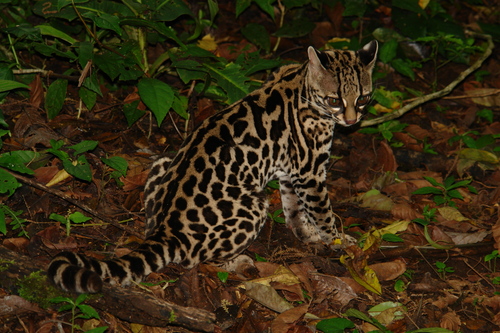
Panthera onca augusta, aussi connu sous le nom de Jaguar du Pléistocène Nord-Américain, est une sous-espèce éteinte de Jaguar (Panthera onca), dans la famille des Felidae. Elle aurait vécu en Amérique du Nord durant le Pléistocène. Description Legendre et Roth ont examiné et comparé la masse corporelle de deux spécimens de Panthera onca augusta.
Panthera onca augusta is an extinct subspecies of the jaguar that was endemic to North America from Middle to Late Pleistocene epoch. History and naming Initial finds The first published fossils were found on the Loup Fork of the Platte River in Nebraska, initially misinterpreted as the Niobrara River, by Ferdinand Vandeveer Hayden in 1857. Hayden sent the fossils to Joseph Leidy at the Academy of Natural Sciences in Philadelphia, who named Felis augustus in 1872 based on these remains.
El jaguar, yaguar, yaguareté, jaguareté, tigre o tecuán (Panthera onca) es un mamífero carnívoro félido de la subfamilia de los Panterinos y género Panthera. Es la única de las cinco especies actuales de este género que se encuentra en América. También es el mayor félido de América y el tercero del mundo, después del tigre (Panthera tigris) y el león (Panthera leo).
Distribution